
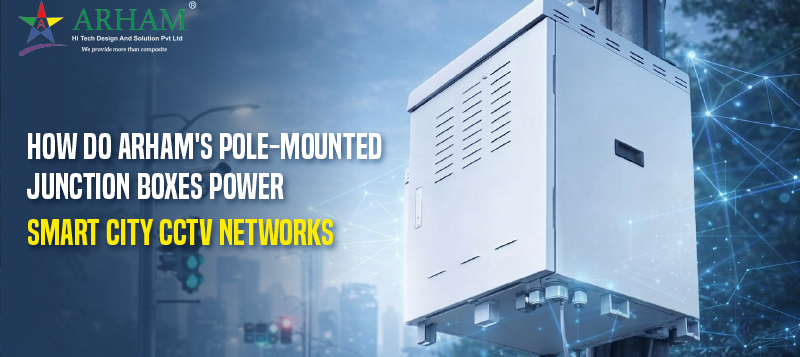
Walk down any busy road in a city and look up. There is a good chance you will spot a camera on a pole, quietly watching the street below. Traffic violations get caught. Missing persons get traced. Accidents get recorded. Most people never stop to wonder what is actually keeping it running. Most people never stop to wonder what is actually keeping it running. The answer is closer than you think. Just a few feet below the lens, attached to the same pole, is a compact box that handles the power, connectivity, and protection that keep the camera alive. They are called smart city pole-mounted junction boxes.
Over the past decade, India has added thousands of cameras across hundreds of cities, covering traffic junctions, public spaces, and sensitive zones. Every single one needs power, a stable data connection, and protection from rain, heat, dust, and vandalism. The junction box handles all of that, quietly, around the clock.
Table Of Contents
- How Are CCTV Cameras in Smart Cities Connected and Powered on Street Poles?
- What Is Actually Inside The Smart City Pole-Mounted Junction Boxes?
- What Role Do Smart City Pole-Mounted Junction Boxes Play in Keeping Urban Surveillance Systems Running Smoothly?
- How Do Cities Manage Wiring and Power Distribution for Large-Scale CCTV Networks?
- What Makes Pole-Mounted Electrical Boxes Reliable for Outdoor Surveillance Infrastructure?
- How Do Modern Cities Ensure an Uninterrupted Power Supply to Roadside Security Cameras?
How Are CCTV Cameras in Smart Cities Connected and Powered on Street Poles?
Most people assume a CCTV camera just needs power and a wire back to a control room. It is a bit more involved than that.
Every camera on a smart city pole is part of a larger network. It needs power, a way to send video data back to a central system, and protection for all the connections involved. Running individual cables from every camera across an entire city would be expensive and nearly impossible to maintain.
Instead, cities use a distributed approach. At each pole or cluster of poles, a junction box acts as a local hub. It receives power from the grid, distributes it to the camera and connected equipment, and manages the data flow from that point. The connections inside are organized carefully:
- Power cables come in from the main supply line
- A Power Distribution Unit (PDU) inside the box splits and regulates that power to each connected device
- Network cables or fibre connections carry video data from the camera back toward the central monitoring system
- Cable entry points are sealed with special glands to prevent moisture or dust from getting inside
It is a tightly managed setup inside a relatively small enclosure, and it needs to work correctly every single day.
What Is Actually Inside The Smart City Pole-Mounted Junction Boxes?
Open one of these enclosures, and everything inside has a place and a purpose.
Equipment shelves hold devices such as network switches and recorders. Cable managers keep wires from tangling. Cooling fans kick in automatically when the temperature rises, which happens often when electronics are packed into a sealed box sitting under the afternoon sun. The door has a lock, sometimes two, with provision for a padlock, because these boxes sit in public spaces and need to be tamper-resistant.
Some enclosures also have an LED light that turns on when the door opens. For a technician doing maintenance on a roadside pole at night, that is not a small thing.
What Role Do Smart City Pole-Mounted Junction Boxes Play in Keeping Urban Surveillance Systems Running Smoothly?
Cities spend heavily on cameras and very little on what protects them. And that is usually where the problem starts. A high-end camera connected to a poorly protected enclosure is still a weak link. Water gets in, corrosion starts, a connection fails, and the camera goes offline. Multiply that across thousands of locations, and the gaps in coverage add up quickly.
Junction boxes solve this by acting as the protective layer between the outdoor environment and the electronics inside. The better the enclosure, the longer everything inside it lasts.
This is why IP ratings matter. IP stands for Ingress Protection and tells you how well an enclosure resists dust and water. IP65 is fully dustproof and handles water jets from any direction. IP66 goes further, handling more powerful water exposure. For a box sitting outdoors through monsoon season, that rating is not a marketing claim. It is a requirement.
Have a Look At: Are Transparent Windows in Instrument Enclosures More Than Convenience
How Do Cities Manage Wiring and Power Distribution for Large-Scale CCTV Networks?
Managing one camera is easy. Hundreds of cameras spread across a city is a different challenge entirely.
The solution is boxes built the same way and installed at every location. Every box is built to the same spec and works the same way regardless of where it is installed. This makes maintenance predictable. A technician who services one box already knows what to expect at the next. The wiring inside follows a clear structure:
- Main power input enters through protected cable glands at the base or side of the enclosure
- The PDU distributes power in controlled, separate circuits to avoid one fault taking down everything
- Data cables are routed separately from power cables to prevent interference
- Everything is labelled and organised so that field technicians can identify and fix issues quickly
This kind of standardisation is what allows city-scale surveillance networks to function without requiring an army of specialists to maintain them.
What Makes Pole-Mounted Electrical Boxes Reliable for Outdoor Surveillance Infrastructure?
Reliability in an outdoor enclosure comes down to three things: material, sealing, and heat management.
- Material matters because these boxes face everything the weather can throw at them. Metal handles impact well when properly treated. FRP, or Fibre Reinforced Plastic, is increasingly popular because it does not rust, does not conduct electricity, and holds up well in humid or coastal conditions. It is also lighter, which makes pole installation easier.
- Sealing matters because even a small gap lets moisture in. Quality enclosures use gaskets and sealed cable entry points to keep the inside stable regardless of what is happening outside.
- Heat management matters because electronics generate heat and heat shortens equipment life. Thermostat-controlled fans handle this automatically, kicking in when the internal temperature crosses a set threshold and switching off when it drops back down.
How Do Modern Cities Ensure an Uninterrupted Power Supply to Roadside Security Cameras?
Power cuts happen. Grid fluctuations happen. A camera that goes dark during an outage is a gap in coverage at exactly the moment it might be needed most.
Most serious smart city deployments handle this with an integrated UPS (Uninterruptible Power Supply) inside the junction box. When the main power drops, it switches to battery backup instantly with no interruption to the camera or connected equipment.
Battery capacity determines how long the system can run on backup power. It depends on where the camera is, how often the power cuts out, and how much that particular feed matters. Either way, everything needed to keep the camera running is in one place, on the pole itself.
The Bigger Picture
A surveillance network is only as good as the infrastructure behind it. The cameras get the attention, but it is the smart city pole-mounted junction boxes that power and protect them and ultimately determine whether the whole system actually holds up.
If you are working on a smart city, safe city, or large-scale CCTV project and need enclosures built for real outdoor conditions, Arham Composite offers pole-mounted junction boxes designed and tested for exactly these deployments. Get in touch with the team to discuss what your project needs.
Frequently Asked Questions
- Can one junction box support multiple cameras?
Yes, a single junction box can power and manage several cameras, depending on its size and the equipment configured inside it.
- What happens to the camera if the junction box is damaged?
If the enclosure is compromised, the electronics inside are exposed to moisture and heat, which will eventually take the camera offline.
- How often do these junction boxes need maintenance?
A well-built enclosure with standardised components needs only periodic checks, and a technician familiar with one box can service any other without additional training.
