
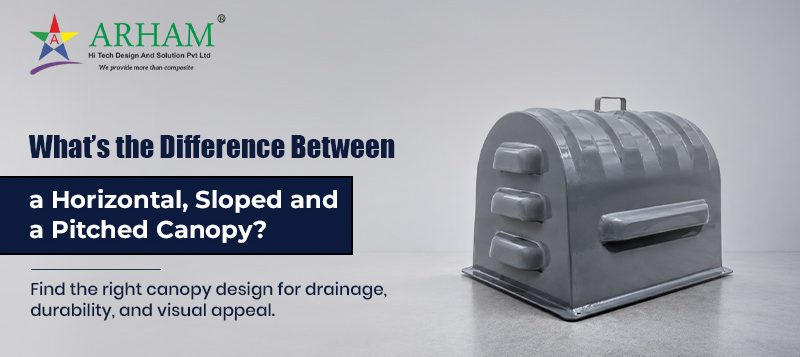
A horizontal canopy lies flat, a sloped canopy angles in one direction to shed water, and a pitched canopy peaks in the middle like a roof. The shape determines how each one handles rain, wind, and load. The wrong canopy for a location pools water, catches wind badly, or cannot handle what is sitting beneath it. A horizontal canopy, a sloped canopy, and a pitched canopy all serve different purposes. Knowing which one fits where is what prevents the wrong call.
Table of Contents
- Does a Horizontal Canopy Drain Water Properly, or Does It Pool on Top?
- Which Canopy Type Handles Heavy Rain and Wind Better?
- Can a Horizontal Canopy Be Installed Over a Motor or Industrial Equipment Safely?
- Is a Sloped Canopy Stronger Than a Horizontal One Under Load?
- Which Canopy Type Is Easier to Install and Maintain Over Time?
Does a Horizontal Canopy Drain Water Properly, or Does It Pool on Top?
A horizontal canopy does not drain on its own. Water pools on a flat surface unless the design includes a slight internal pitch or an integrated gutter to direct runoff. A well-made horizontal canopy will account for this during manufacturing. Flat roof canopy water drainage is one of the first things to confirm with your supplier before ordering. Here’s what to check before installing a horizontal canopy:
- Built-In Drainage Gradient: Not all flat canopies handle water the same way. Check whether the design includes a gradient that moves water toward an outlet rather than letting it sit.
- Gutter and Drain Outlet Positioning: A gutter that drains to the wrong side just moves the problem. Confirm that the outlets are positioned to completely clear water from the surface.
- Surface Finish: A rough or textured surface collects debris faster than a smooth one. Ask about the finish before ordering if the canopy will be exposed to leaves, dust, or industrial fallout.
- Edge Fixings and Seals: Water finds gaps at the edges before anywhere else. Make sure fixings and seals are watertight before installation, not after the first rain.
- Standing Water Load Rating: An FRP canopy load-bearing rating for its own weight may not include standing water from heavy rain. Add this case to the load rating check.
Which Canopy Type Handles Heavy Rain and Wind Better?
A flat vs. pitched canopy comparison comes down to how each shape handles water and wind. A pitched canopy sheds water faster. Two sloped sides that meet at a central ridge drain rainwater in both directions without relying on gutters, unlike a flat canopy. A horizontal canopy handles moderate rainfall reliably when drainage is built into the design. Wind performance depends more on fixing quality than shape alone.
Can a Horizontal Canopy Be Installed Over a Motor or Industrial Equipment Safely?
A horizontal canopy works well as a weather cover for industrial equipment when properly sized and ventilated. It protects without restricting airflow, which matters for motors that generate heat during operation and need circulation to perform reliably. Canopy installation over machinery requires enough clearance between the cover and the equipment below to allow heat to escape.
If it’s too tight, you trap heat, and if it’s too loose, the cover offers less effective weather protection. So the key is getting the right size.
Continue Reading: Top 5 Benefits of Installing a Motor Canopy for Your Motors
Is a Sloped Canopy Stronger Than a Horizontal One Under Load?
A sloped canopy better handles gravity loads. Rain, debris, and snow shed off quickly without accumulating. A horizontal canopy sits lower and presents less surface to crosswinds, which gives it an edge on wind uplift. Both have their strengths depending on what the site throws at them.
Which Canopy Type Is Easier to Install and Maintain Over Time?
A horizontal canopy is installed pretty easily. The fitting stage requires some thought around drainage positioning, but that is straightforward when planned. Of the three types, a sloped canopy installs fastest, and a pitched canopy takes the longest due to the components at the ridge junction.
Once installed, a horizontal canopy needs very little attention, as FRP needs no painting or coating.
Conclusion
Canopies do more than cover things. The shape determines how water moves, how load is handled, and how long the structure holds up. Our team manufactures canopies across all three types and can help match the right one to your site conditions. Talk to Arham Composite to get the specification right from the start.
Stay tuned for the next blog, where we cover what most sites get wrong when specifying protective covers for industrial equipment.
Frequently Asked Questions
- What mounting types are available for Arham’s FRP motor canopies?
Arham manufactures horizontal, vertical, and eye-bolt-mounted motor canopies in FRP/GRP, available in three grades depending on whether the site is hazardous or non-hazardous.
- How long does an FRP motor canopy last outdoors?
FRP motor canopies resist chemical spillage, rain, direct sunlight, and mechanical shocks without degrading, making them a low-maintenance option for industrial environments.
- Can a canopy be sized to fit any motor?
Yes, Arham Composite sizes motor canopies based on the motor’s physical dimensions, maintaining at least 50mm clearance between the cover and the motor.
