
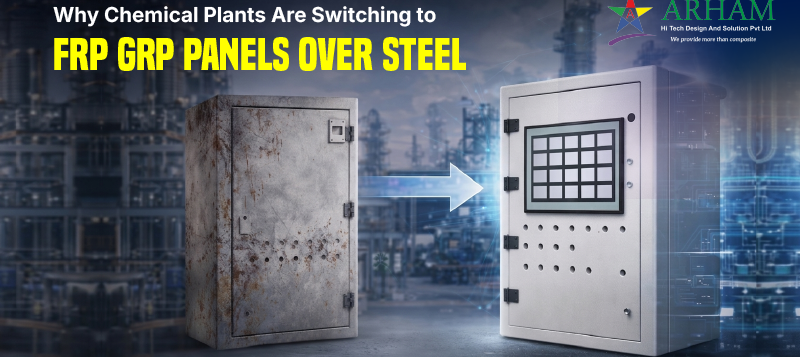
Steel rusts. Most industries can live with that. Chemical plants cannot. Between the fumes, the acid exposure, and the constant humidity, steel infrastructure in these facilities takes a beating. Maintenance teams end up spending more time managing corrosion than anything else. At some point, the costs stop adding up, and that is when switching to FRP GRP panels becomes the obvious move.
Table Of Contents
- What Exactly Are FRP/GRP Panels?
- Why Are Chemical Plants Replacing Steel with FRP and GRP Panels?
- What Makes FRP and GRP Panels More Reliable Than Steel in Corrosive Environments?
- How Do FRP and GRP Panels Improve Durability in Chemical Processing Units?
- Are FRP and GRP Panels More Cost-Effective Than Steel Over Time?
- What Maintenance and Safety Benefits Do FRP and GRP Panels Offer Compared to Steel?
- Things to Keep in Mind Before You Switch To FRP GRP Panels
What Exactly Are FRP GRP Panels?
FRP stands for Fibre Reinforced Plastic. GRP stands for Glass Reinforced Plastic. They are essentially the same material, just referred to differently across industries. Both are made by combining glass fibres with a plastic resin, resulting in something lighter than steel, corrosion-resistant, and built to last in environments that would eat through metal over time.
What makes them well-suited for chemical plants is that the resin can be matched to the materials the facility actually handles. Acids need a different formulation than alkalis. Steel does not offer that kind of specificity.
Why Are Chemical Plants Replacing Steel with FRP and GRP Panels?
Steel has one problem in chemical environments, and it is a big one: it corrodes. Not because it is poor quality or badly made. Just because metal and chemical fumes and moisture, day after day, year after year, is a combination that always ends the same way.
Here is what that usually looks like in a chemical plant over time:
- Panels start rusting at joints and edges where protective coatings wear off first
- Maintenance teams repaint and treat surfaces regularly just to slow the process down
- Eventually, sections need replacing, which means downtime, labour costs, and new material
- Meanwhile, the structural load from heavy steel panels puts stress on the supporting frameworks
- In coastal or high-humidity zones, the whole process accelerates
None of it happens overnight. It just builds up quietly until the cost of staying with steel outweighs the cost of switching.
Read This Blog Next: How FRP Transmitter Enclosures Withstand Harsh Climates and Corrosion
What Makes FRP and GRP Panels More Reliable Than Steel in Corrosive Environments?
The short answer is no. They do not react to the things that destroy steel.
FRP and GRP do not rust. Be it acids, alkalis, salts, or chemical fumes, the panels handle them all without degrading the way metal does. The same environment that wears steel down year after year leaves these panels largely unchanged.
That is why they usually last fifteen to twenty years or more in conditions where steel needs serious attention long before that. They are also non-conductive, which matters in any facility where electrical equipment and chemical vapours are both present.
How Do FRP and GRP Panels Improve Durability in Chemical Processing Units?
Durability in a chemical plant is not just about whether something holds together. It is about whether it causes new problems in the process.
Corroding steel panels do not just look bad. Rust flakes off. Surfaces break down. In a facility handling chemicals, that kind of contamination is a real concern, not just an aesthetic one.
FRP and GRP panels do not behave that way. They do not warp in heat or swell in moisture. A panel that goes in correctly stays that way—same shape, same performance, years down the line.
They are also much lighter than steel, roughly a quarter of the weight. That means less stress on the structures that hold them, simpler installation, and lower costs for getting them to the site in the first place.
Are FRP and GRP Panels More Cost-Effective Than Steel Over Time?
The upfront cost of FRP and GRP panels can be higher than that of steel. That is worth saying clearly because it is the first thing that comes up in most conversations about switching. The actual situation is different, though:
- Steel: Lower initial cost, but requires regular painting, coating, and surface treatment. Sections that corrode need replacing. Repairs mean the facility is not running at full capacity, and that has its own cost.
- FRP / GRP: Higher initial cost, but essentially zero maintenance requirements. No painting. No rust treatment. A significantly longer lifespan in conditions that would have worn steel down much sooner.
Once corrosion maintenance is removed from the budget, the initial cost difference takes care of itself. The lighter weight helps with installation, too. Smaller crews, less equipment, faster completion. On a large project, that is a real saving.
What Maintenance and Safety Benefits Do FRP and GRP Panels Offer Compared to Steel?
There is not much to maintain. No repainting, no surface treatment, no rust management. Most installations just need a routine check every so often to confirm everything is in order. On the safety side, a few things are worth knowing:
- Non-conductive, so there is no electrical risk in areas running high-voltage equipment near chemical vapours
- Can be made with textured, anti-slip surfaces for walkways and flooring that stay safe even when wet or oily
- Fire-retardant grades are available for zones where fire safety standards need to be met
- No rust or surface degradation means no contamination risk to surrounding areas or products
Things to Keep in Mind Before You Switch To FRP GRP Panels
A few things are worth getting right from the start:
- For outdoor use, UV stabilisation should be part of the specification. Most good panels include it, and it helps the surface perform well over the long term.
- Matching the resin to the chemical environment is the other key decision. The right formulation is what allows the panel to hold up against what the facility actually handles, so it is worth discussing the specifics with a manufacturer before anything is ordered.
- On installation, the usual details apply. Proper overlaps, corrosion-resistant fasteners, sealed joints. Do those things correctly, and the material takes care of the rest.
Conclusion
For a long time, steel was simply what everyone used. In chemical environments, it just does not hold up the way it used to. The corrosion keeps coming, the maintenance keeps growing, and at some point, the case for switching becomes hard to ignore. FRP GRP Panels are what most facilities land on when they reach that point. There is no corrosion, low maintenance, and a lifespan that steel cannot match in these conditions.
Arham Composite manufactures FRP/GRP Panels designed for exactly these environments. Get in touch, and we will take care of everything from there.
Frequently Asked Questions
- Can FRP and GRP panels be used in both new construction and existing chemical plant upgrades?
Yes, they can be fitted into new builds or used to replace corroding steel in existing facilities without major structural changes.
- Do FRP and GRP panels require any special tools or expertise to install?
Standard installation requires proper overlaps, corrosion-resistant fasteners, and sealed joints, which any experienced installation team can handle with the right guidance from the manufacturer.
- Are FRP and GRP panels suitable for all types of chemicals handled in processing plants?
Not every panel suits every chemical environment, which is why the resin formulation should always be matched to the specific substances a facility works with before anything is specified or ordered.
