
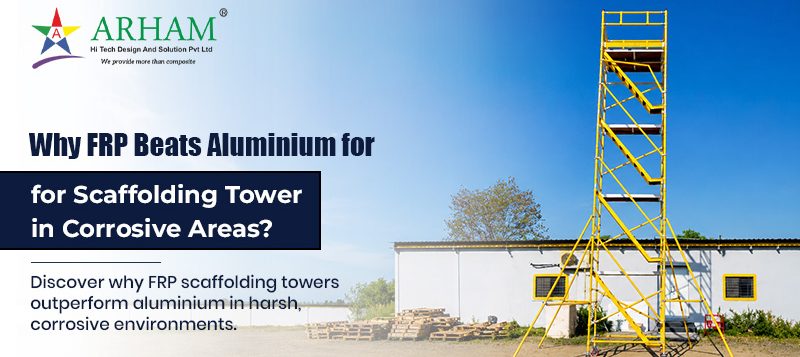
FRP scaffolding lasts longer in harsh environments because it doesn’t corrode like aluminium. If your site has chemical fumes, salt air, or a lot of moisture, that’s the difference between a structure that holds and one that doesn’t.
Chemical plants, coastal sites, and wastewater facilities put materials through a lot. Salt, acid fumes, and moisture don’t stop. Aluminium weakens over time in those conditions, and when scaffolding weakens, it becomes a safety problem. An FRP double platform scaffolding tower with stairways is built to handle exactly those environments.
Table of Contents
- Does FRP Scaffolding Rust or Corrode the Way Aluminium Does in Chemical or Coastal Environments?
- Is an FRP Double Platform Scaffolding Tower Safe to Use Near Acids, Alkalis, or Chemical Fumes?
- Can an FRP Double Platform Scaffolding Tower With Stairways Be Used in Environments Where Electrical Hazards Are Present?
- Is FRP Scaffolding Heavier or Lighter Than Aluminium, and Does That Affect How Easy It Is to Move on Site?
- How Long Does an FRP Scaffolding Tower Last Compared to Aluminium in a Corrosive Environment?
Does FRP Scaffolding Rust or Corrode the Way Aluminium Does in Chemical or Coastal Environments?
FRP doesn’t rust or corrode the way aluminium does. Over time, aluminium breaks down when exposed to saltwater or chemical fumes, with pitting and surface damage appearing sooner than most sites expect. FRP contains no metal, so moisture, salt and acid have nothing to react with. That’s what makes it corrosion-resistant:
- No Metal So No Reaction: FRP contains no iron, steel, or reactive metals. There is nothing in the material for moisture, salt, or chemicals to react with.
- Moisture-Sealed: The polymer matrix wraps around the fibres, keeping moisture out. Damp conditions don’t get into the core of the material.
- Resistance to Chemicals: Acids, alkalis and solvents do not attack the FRP. The chemical resistance is characteristic of the material, not of the coating. That resistance is part of what FRP is, not something applied on top.
- Surface Stays Intact: The surface doesn’t pit, blister, or oxidise over time. What you install is what you still have years later.
- No Coating Needed: FRP doesn’t need a protective coating to stay in good condition. The material holds its own without one.
Read This Next: Single vs Double Platform Scaffolding: Which Is Right for Your Project
Is an FRP Double Platform Scaffolding Tower Safe to Use Near Acids, Alkalis, or Chemical Fumes?
FRP scaffolding is safe to use near acids, alkalis, and chemical fumes. The material doesn’t absorb chemicals, and its surface doesn’t deteriorate under direct exposure, unlike metal frames whose protective coatings deteriorate with time.
Can an FRP Double Platform Scaffolding Tower With Stairways Be Used in Environments Where Electrical Hazards Are Present?
FRP scaffolding towers are safe to use where electrical hazards are present because the material does not conduct electricity. Aluminium does, and that matters in petrochemical plants, electrical substations, or anywhere live equipment sits near the work area.
Workers on a fibreglass scaffolding tower are not at risk of conducting a fault through the structure. That single characteristic has made FRP the default choice in several high-risk industries.
Environments Where Non-Conductivity Changes Everything
- High-Voltage Proximity: Petrochemical refineries run high-voltage equipment close to where workers operate. A conductive scaffold in that space is a risk that doesn’t need to be there.
- Live Equipment Shutdowns: Power generation facilities don’t always go fully offline during maintenance. Workers on a non-conductive tower aren’t dependent on every switch being in the right position.
- Dual Hazard Environments: Chemical processing plants handle fumes and live equipment simultaneously. A conductive structure makes both problems harder to manage.
- Saltwater and Live Systems: Marine installations run electrical systems in the same space where saltwater gets into everything. A non-conductive frame removes one variable from that equation.
- Submerged Electrical Infrastructure: Wastewater treatment sites run submersible pumps below the work area. Any fault that travels through a conductive scaffold puts workers directly in the path.
Is FRP Scaffolding Heavier or Lighter Than Aluminium, and Does That Affect How Easy It Is to Move on Site?
FRP is comparable in weight to aluminium and, in some configurations, lighter, which still makes a difference when repositioning on a busy site. On a busy industrial site where a double-platform tower with a stairway needs to be repositioned multiple times a day, it matters a lot. Lighter components mean less strain during assembly and movement, which lowers injury risk and gets the job done faster.
How Long Does an FRP Scaffolding Tower Last Compared to Aluminium in a Corrosive Environment?
FRP scaffolding is more durable in corrosive environments because the material doesn’t corrode like aluminium. Aluminium in coastal or chemical conditions needs regular inspection, cleaning, and eventual replacement. FRP maintains its structural integrity without fighting a losing battle against its surroundings, bringing the long-term cost closer to aluminium than the upfront price difference suggests.
Conclusion
The choice between FRP and aluminium comes down to how the environment affects the material over time. In corrosive, chemically active, or electrically hazardous sites, FRP holds up longer and keeps workers safer. For teams that cannot afford downtime or structural failure, that is the practical decision. For industrial scaffolding built to handle what your site throws at it, contact Arham Composite and find out which configuration suits your environment.
Not every extinguisher box survives a chemical-heavy site. The next blog tells you which one does. Keep an eye out.
Frequently Asked Questions
- Can FRP scaffolding be used outdoors in all weather conditions?
Yes, FRP handles UV exposure, moisture, and temperature fluctuations without warping or degrading.
- Does FRP scaffolding meet standard load-bearing requirements?
Yes, FRP scaffolding is engineered to meet the same load capacity standards as conventional metal scaffolding.
- Is FRP scaffolding difficult to assemble compared to aluminium?
No, modular FRP systems are designed for straightforward assembly with standard fittings.
